Why naturist couples say they feel closer. Science has a name for it.
Published on freehiking.eu
There’s something that comes up again and again when we talk to couples who’ve been practising naturism together for years. Not just the usual reasons, freedom, connection with nature, leaving body shame behind. Something more specific, and harder to put into words.
They feel closer to their partner than before.
Not in the abstract way that people say «travel brings you closer.» In a physical, present-tense way. As if something that had been quietly switched off got switched back on.
We’ve been thinking about why that is. And it turns out, science has been thinking about it too.
The thing that disappears without anyone noticing
There’s a concept in psychology and physiology called skin hunger, or, in more formal literature, touch deprivation. It refers to the chronic lack of meaningful, non-sexual physical contact. And it’s far more common than most people realise, especially in long-term couples.
Here’s the paradox: you can share a bed, a bathroom, a life with someone, and still be touch-starved. Because what the body needs isn’t proximity. It’s intentional contact. The kind that says: I’m here. You’re real to me. I see you.
What tends to disappear first in long-term relationships isn’t sex. It’s the contact without agenda. The long hug in the kitchen. Sleeping entwined. Touching each other’s arm in the middle of a conversation, not because it leads anywhere, but because you wanted to.
When that quiet layer of contact erodes, and it erodes slowly, almost invisibly, the body notices before the mind does. Couples report feeling emotionally distant from each other without being able to explain why. Irritability. A vague sense that something is missing. Sometimes they assume they’ve simply grown apart.
Often, they haven’t. Their bodies have just stopped speaking to each other.
What happens when you take the clothes off
Naturism doesn’t fix this automatically. It’s not magic. But it creates conditions that are remarkably well-suited to addressing it, and that’s not accidental.
When you strip away clothing in a social naturist context, you also strip away a significant layer of social armour. Clothing is not just fabric. It’s role, status, presentation. The work shirt. The carefully chosen outfit. The way you want to be perceived today. Without it, something softens. Not just physically, socially, too.
For couples, this has a specific effect. The performative layer falls away. You’re not the version of yourself that goes to the office, or handles the school run, or manages the household. You’re just a body, next to another body, in nature. And that person next to you is not playing their role either.
Many couples describe their first naturist experience together as unexpectedly intimate. Not erotic, intimate. There’s a difference. Intimacy is being truly seen by another person. And it’s very difficult to feel truly seen when you’re both armoured up.
The oxytocin loop (and why skin matters)
The skin is the body’s largest organ. It’s also densely packed with receptors that trigger the release of oxytocin, the hormone most associated with bonding, trust, and social connection, when stimulated by warmth and gentle contact.
Sun. Wind. Water. Another person’s gaze on your body without judgment.
All of these activate those receptors. All of them feed the same neurochemical loop that physical touch does. And in a naturist environment, the skin is exposed to all of them simultaneously, continuously, for hours.
This isn’t speculation. Research on affective touch, the kind of touch associated with social bonding rather than information transfer, shows that it activates a specific set of nerve fibres (C-tactile afferents) that are distinct from those used in functional touch. These fibres respond best to light, slow, skin-temperature contact. They are, essentially, wired for connection.
Naturism, especially in warm outdoor settings, keeps this system gently active for extended periods. The body stays in a low-level state of openness and receptivity that’s hard to replicate in a clothed, indoor, screen-saturated environment.
The role of shared vulnerability
There’s another dimension that’s less about physiology and more about relational psychology.
Being naked in a social or natural setting requires a specific kind of courage, especially the first few times. And doing something courageous together, sharing a vulnerability, stepping outside a comfort zone in each other’s presence, is one of the most reliable ways to strengthen a bond.
Psychologists call this vulnerability reciprocity. When two people expose themselves to the same discomfort or uncertainty together, they tend to feel more connected afterwards. The experience creates a shared reference point. We did that together. It becomes part of the story of the relationship.
For couples who naturism has become a regular practice, the effect compounds over time. Every trip, every new place experienced together without the usual social layers, builds on the previous ones. The shared history of vulnerability becomes a kind of intimacy infrastructure.
It’s not about bodies. It’s about presence.
One thing worth saying clearly: naturism, in the context we’re describing, has very little to do with how bodies look. The couples who report feeling closer through naturism are not couples who suddenly feel better about their physical appearance (though that sometimes happens too). They’re couples who have found a context in which the body stops being a performance and starts being a presence.
That distinction matters. A lot of people assume that naturism must be either exhibitionist or about physical confidence. It’s neither, necessarily. At its core, it’s about letting the body exist without the constant low-level management that clothed life requires. That management, sucking in, covering up, presenting, adjusting, is exhausting in ways we stop noticing. When it stops, something relaxes that had been tense for years.
For couples, that shared relaxation is itself a form of contact.
What we’ve noticed
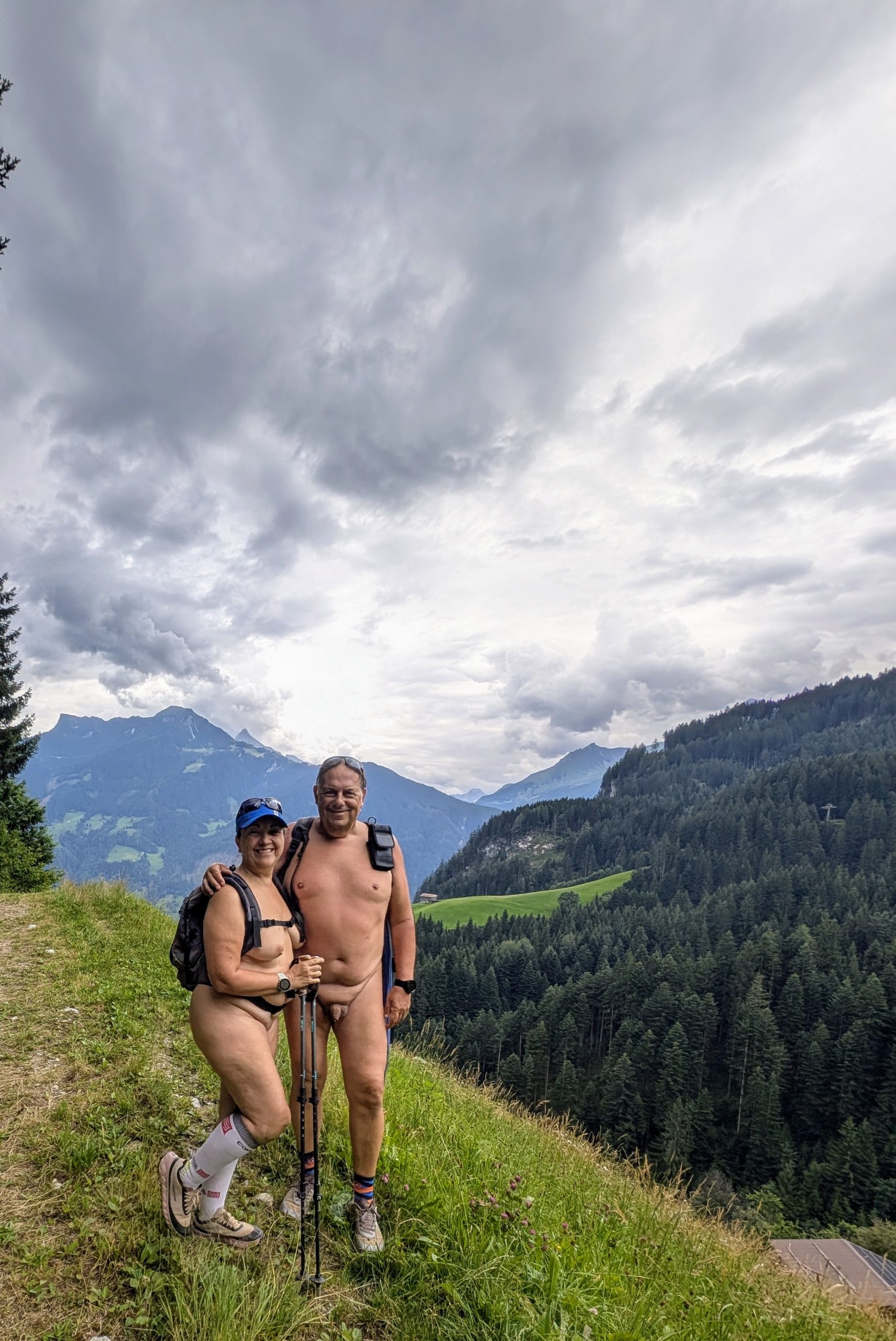
We’ve been living and travelling as a naturist couple for a long time. The science above confirms something we’d felt but couldn’t always name.
The trips that have brought us closest together weren’t the most spectacular destinations. They were the ones where we spent entire days with nothing between us and the world, no layers, no roles, no agenda. Just bodies in nature, next to each other.
There’s a quality of presence in those moments that’s genuinely hard to replicate elsewhere. And we’ve met dozens of naturist couples over the years who describe the same thing, in their own words, without prompting.
Something about taking the clothes off takes something else off too.
If this resonates further than you expected
The connection between physical contact, body presence, and intimacy in couples is something we also explore in our massage practice. If the idea of touch starvation struck a chord, the quiet erosion of intentional contact in long-term relationships, we wrote more directly about it here:
→ When two people sleep together every night and still feel alone (lomilomimassage.cat)
Angela & Carles — Travel Naked Couple freehiking.eu | acexplora.com | @travel_nkd